 ShoosOn
 More Ways to Run: Every ShoosOn Run Type Available Now
ShoosOn now includes a wider mix of easy runs, recovery runs, long runs, tempo sessions, hill work, intervals, strides, fartlek and aerobic pace check-ins.
Running progress rarely comes from doing the same run over and over again.
There is a place for a simple steady loop. In fact, “easy” running is still the foundation of almost every good plan. But if every run feels identical - same pace, same route, same effort, same slightly bored conversation with yourself - training can start to feel flat long before your fitness has stopped improving.
ShoosOn now gives runners a much broader set of coached run types, available in the app today. The adaptive coach can mix aerobic runs, recovery days, long runs, hill work, speed sessions, race-specific tune-ups and regular aerobic check-ins into a week that feels more varied, more purposeful and less repetitive.
The aim is not to make running complicated. The aim is to make each run useful.
Why more run types matter
Different runs create different adaptations. Easy runs build the aerobic base. Recovery runs help you absorb the work. Long runs extend endurance. Tempo sessions improve your ability to hold a strong pace. Shorter intervals sharpen speed, power and running economy.
That variety matters for motivation too. A runner who only sees “run 40 minutes” every Tuesday may technically have a plan, but it can feel mundane very quickly. A week that includes an easy run, a recovery jog, a few relaxed strides, a long run and the occasional focused quality session gives your training a clearer rhythm.
ShoosOn uses that mix to help your running feel less like repetition and more like progression: some days build the engine, some days freshen the legs, some days test the gears, and some days simply keep the habit alive.
All ShoosOn run types available now
These are the coached run types currently available in ShoosOn. Some appear regularly in the adaptive coach, while others are used at specific points in a training phase, during a taper, or when the app has enough data to make the session useful.
| Run type | Short description | Aim | Specific benefit |
|---|---|---|---|
| Easy runs with target pace | A continuous comfortable run, usually guided by your easy pace when ShoosOn has enough data. | Build your aerobic engine without pushing too hard. | Improves endurance while leaving enough energy for the rest of the week. |
| Recovery runs with target heart rate | A very gentle jog, often capped by heart rate instead of pace. | Keep the legs moving while keeping fatigue low. | Helps you absorb harder sessions and avoid turning every run into a workout. |
| Long runs | A longer continuous run at an easy, sustainable effort. | Extend time on feet and build endurance for bigger distances. | Strengthens aerobic capacity, durability and confidence over distance. |
| Progression long runs | A long run that starts easy, then finishes with the final section closer to marathon effort. | Practise running well when tired. | Builds race-relevant strength without needing a separate hard session. |
| Aerobic pace check-ins | A standardised run with a controlled 20-minute block at a fixed heart-rate range. | Measure how your pace changes at the same easy effort over time. | Shows aerobic efficiency improving without needing an all-out test. |
| Tempo runs | A sustained comfortably hard effort between easy running and racing. | Raise the pace you can hold before fatigue builds quickly. | Improves threshold fitness, especially useful for 10K and half-marathon goals. |
| Cruise intervals | Repeated threshold efforts, such as 1 km reps, with short jog recoveries. | Get tempo-style benefits in more manageable chunks. | Lets you hold strong form and pace for more total quality work. |
| VO2 intervals | Hard repeated efforts, usually several minutes long, with jogging recovery. | Push your aerobic ceiling higher. | Improves oxygen use, speed and overall fitness in a focused session. |
| Speed repeats | Short fast reps, such as 400 m repeats, with proper recovery. | Sharpen speed, coordination and running mechanics. | Makes faster running feel smoother and improves running economy. |
| Race-pace intervals | Controlled reps at your goal race pace, often used near race day. | Tune your body and mind to the exact pace you want to run. | Builds confidence and pacing instinct without adding heavy fatigue. |
| 10-20-30 intervals | A fast-changing session cycling 30 seconds easy, 20 seconds moderate and 10 seconds very hard. | Add a compact, high-energy speed stimulus. | Breaks hard running into short pieces so the session feels lively and achievable. |
| Hill repeats | Longer uphill efforts with easy recovery back down. | Build strength and power using the hill as resistance. | Develops force, form and toughness with less impact than flat speed work. |
| Hill sprints | Very short maximum-effort uphill bursts with full walk-back recovery. | Recruit power and fast-twitch fibres in tiny doses. | Improves speed and economy with surprisingly low overall fatigue. |
| Strides | Short relaxed accelerations, usually added near the end of an easy run. | Keep your legs sharp without making the day hard. | Improves turnover, posture and smooth speed while preserving recovery. |
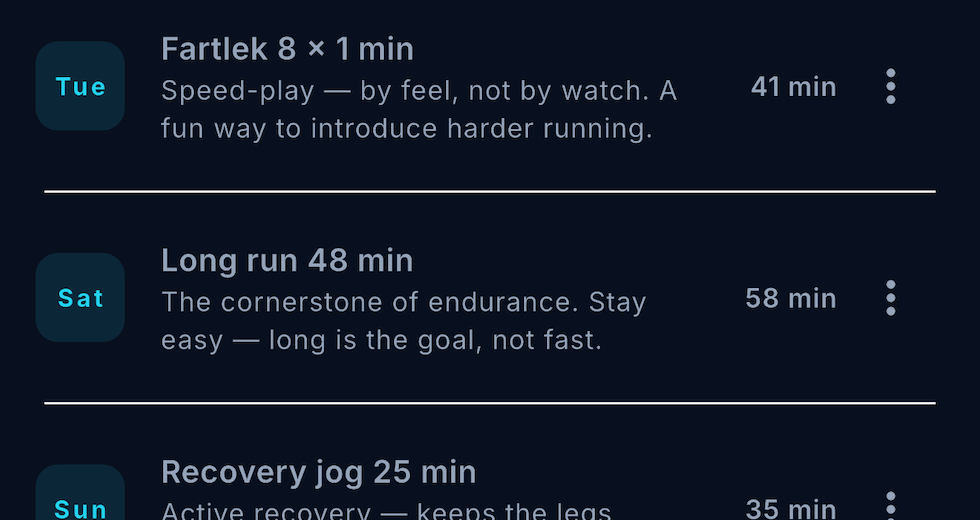
| Fartlek | Speed play: short faster bursts mixed into easier running by feel. | Add variety and speed without rigid splits. | Keeps training fun, develops pacing instinct and breaks up routine. |
Easy does not mean wasted
One of the easiest training mistakes is to make every run medium-hard. It feels productive in the moment, but it often leaves runners stuck: too tired to run fast, too strained to recover properly, and not fresh enough to enjoy the next session.
That is why ShoosOn keeps easy runs, recovery runs and long runs in the mix. They are not filler. They are the work that makes the rest of the plan possible.
Easy runs develop the aerobic base. Recovery runs protect the week from becoming a grind. Long runs build the endurance that supports everything from a first 10K to a marathon build. When those runs are guided by target pace or heart rate, they also make it easier to stay honest: easy enough to work, not so hard that they quietly steal from tomorrow.
Quality sessions with a purpose
The newer quality sessions give the coach more ways to target specific fitness.
Tempo runs and cruise intervals both work around threshold effort, but they feel different. A tempo run asks you to settle into one sustained block. Cruise intervals break that work into repeatable pieces, making it easier to hold form and confidence as you build.
VO2 intervals and speed repeats sit higher up the intensity ladder. VO2 intervals are hard enough to raise your aerobic ceiling. Speed repeats are shorter and sharper, improving coordination, stride mechanics and economy. Race-pace intervals are different again: less about proving fitness, more about learning the pace you want to trust on the day.
Then there are 10-20-30 intervals, which add a punchy change of rhythm. Because the effort changes every few seconds, the session feels active and focused rather than monotonous. It is hard work, but the pieces are short enough to keep you engaged.
Hills, strides and speed play
Not all variety has to come from chasing a split.
Hill repeats use the hill itself as the training tool. The pace will naturally slow, but the strength demand goes up. That makes them useful for power, form and mental toughness.
Hill sprints are shorter and more explosive: just a few seconds of maximum effort with full recovery. They are intense in the moment, but the total hard running time is tiny, so they can build power without turning the whole week into a sufferfest.
Strides sit at the lighter end of the speed spectrum. They are fast but relaxed, often added after easy running to remind your legs how to move quickly without creating much fatigue.
Fartlek keeps things even looser. Instead of obsessing over perfect splits, you play with effort: a minute harder, a minute easier, or a burst to the next landmark. It is structured enough to help fitness, but free enough to stop training feeling stale.
Check-ins without race-day pressure
The aerobic pace check-in is one of the most useful additions for runners who want progress without constant maximal tests.
Rather than asking you to race a time trial, ShoosOn gives you a controlled block at a fixed heart-rate range. Over time, the question becomes simple: are you moving faster at the same easy effort?
That is a powerful signal. It helps show aerobic improvement even when you are not chasing a personal best, and it gives the coach a cleaner way to understand how your base fitness is developing.
Less repetition, better rhythm
The bigger run-type library gives ShoosOn more ways to make training feel alive.
One week might be mostly easy with strides. Another might bring in cruise intervals. A build phase might include hill sprints or 10-20-30 intervals. A taper might sharpen with race-pace work. The long run stays there as the endurance anchor, while recovery runs give the week room to breathe.
That mix matters because the best running plan is not the hardest plan. It is the plan you can keep following: varied enough to stay interesting, structured enough to keep improving, and flexible enough to adapt when real life changes the week.
ShoosOn is still moving toward general release later this year, and this wider set of run types is a big part of what the app is becoming: a running coach that does more than tell you to run again tomorrow. It helps you understand why each run is there, how to run it, and what it is doing for your fitness.
ShoesOn. And go.
Want early access to ShoosOn as we keep moving toward general release?